
Transforming Customer Service with Voice AI: From IVR to Intelligent Agents
Why legacy IVRs fall short
Last week I called my bank and spent 4 minutes pressing buttons before a robot told me to call back during business hours. We can do better.
Classic IVRs were designed to deflect calls with keypad trees. Today, customers expect fast, human-like help and seamless handoffs when automation can’t resolve an issue. Recent research highlights just how wide the expectation gap has become:
- Speed and simplicity matter, and IVRs are a top frustration. In a 9,500-consumer study, 49% cited long wait times and 42% cited complex IVR options among their top frustrations; only 45% said they regularly receive effective and speedy resolution. Many simply tolerate issues rather than face cumbersome service processes.
- Abandonment rises with delay and complexity. Multiple industry benchmarks flag that abandonment above ~10% is a red flag for slow answers or confusing routing.
Legacy IVRs weren’t built to understand customers; they were built to funnel them. That design constraint now drives cost and churn.
What changes with voice AI
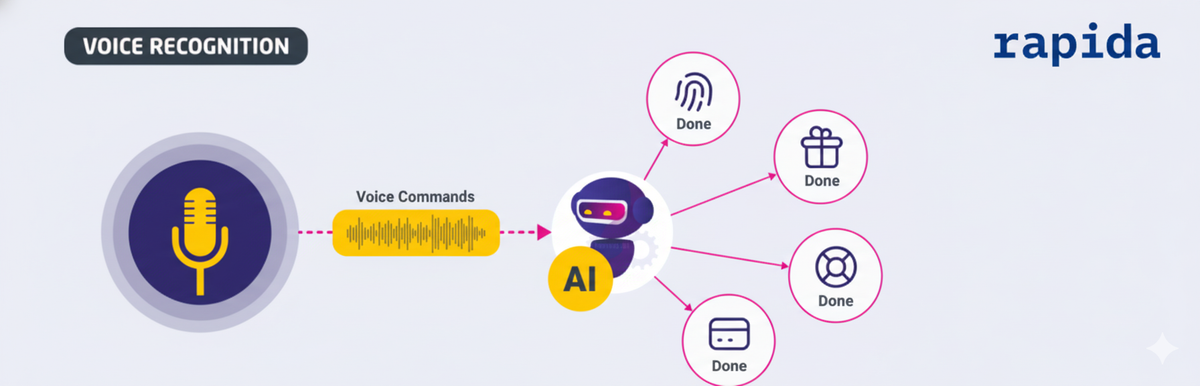
No more button-mashing. Just talk. 'I need to update my payment method' works better than 'press 2 for billing, then 3 for payment options, then...', system detects intent, asks clarifying questions, executes actions, and escalates to humans with full context when needed.
- Conversational IVR (AI-powered) replaces touch-tone navigation with real-time speech understanding, accelerating resolution and reducing friction.
- Low latency is essential to keep the dialogue human-like; platform design choices—streaming ASR, parallel orchestration, efficient TTS—directly impact perceived responsiveness.
- Always on. AI agents answer instantly, 24/7, capturing after-hours demand rather than pushing customers into queues or voicemail.
Behind the scenes, enterprise-grade systems integrate with CRMs, billing, ticketing, and identity providers to authenticate users, retrieve data, and complete tasks—then hand off gracefully when human empathy or judgment is required.
The business case: speed, containment, CSAT, and cost
Reduced wait times & higher containment. Moving common intents to an AI front door removes queue delays and lifts containment for routine requests (balances, delivery status, password resets, plan changes). That combination—near-zero wait plus fewer transfers—directly correlates with higher CSAT and lower abandonment. The Capgemini study above links quicker resolution with satisfaction, while flagging IVR complexity as a fix-worthy pain point.
Lower cost-to-serve. Everyone from Gartner to McKinsey says the same thing on meaningful savings when AI absorbs routine volume:
- Gartner projects that by 2029, agentic AI will autonomously resolve 80% of common service issues, driving a ~30% reduction in operational costs.
- McKinsey finds AI-powered next-best-experience programs can reduce cost to serve by 20–30% while improving satisfaction and revenue.
- Earlier work shows automation can shift a significant share of contacts from human handling, especially in telco and banking.
Agent productivity—without sacrificing empathy. With AI triaging, verifying identity, and gathering context up front, human agents spend more time on complex cases where they add the most value. McKinsey reports examples of material cost-per-call reductions when AI co-pilots and automation are deployed in tandem.
What “good” looks like: design principles
The companies getting this right typically do five things well:
- Start with the call reasons that drive volume. Map intents by frequency and effort. Prioritize high-volume, low-complexity tasks for automation; design explicit handoff criteria for edge cases.
- Engineer for latency. End-to-end round-trip (ASR → NLU/LLM → API → TTS) must feel instantaneous. Stream audio both ways, parallelize orchestration, and pick speech models that balance accuracy and speed.
- Instrument everything. Track real-time metrics: containment, transfer rate, AHT deltas, sentiment, first-contact resolution, abandonment, and deflection. Use transcript analytics to find failure patterns and expand coverage.
- Design for escalation. When confidence is low or sentiment degrades, transfer to human with synthesized conversation summary, verified identity, and action history—no “start from scratch” moments.
- Close the loop. Treat the bot as a product: run intent A/B tests and continuously retrain domain vocabulary. Tune prompts/guardrails to improve factuality and tone.
How Rapida.ai accelerates this transition
Rapida.ai is a voice AI orchestration platform purpose built for enterprise scale and control:
- Multichannel by design: Deploy phone-based agents (PSTN/SIP) and web-based voice experiences with a unified conversation brain—so customers get consistent experiences regardless of entry point.
- Deployment flexibility: Choose SaaS on cloud for speed or on-prem for data residency and tighter control—useful for regulated industries.
- Low-latency orchestration: Streaming ASR/TTS, parallel tool-use, and policy-driven routing minimize response lag to keep interactions natural. (Why this matters beecasue low latency is foundational to conversational UX.)
- Enterprise integration: Connect to CRM, billing, identity, ticketing, and data lakes via APIs and webhooks; capture outcomes to analytics/BI for closed-loop improvement.
- Governance & observability: Centralized policies, audit-ready logging, and PII controls support enterprise compliance while giving CX and IT teams full visibility into bot behavior and performance.
The result: a pragmatic path from legacy IVR to an intelligent voice front door—without ripping and replacing your entire stack on day one.
What outcomes to target in year one
Set pragmatic, measurable goals, then iterate:
- Containment: Automate 30–50% of top intents (password resets, status checks, plan changes) with target CSAT parity or better than human baseline.
- Wait time: Cut average speed of answer to near-zero for automated intents; cap queue time for escalations with priority routing.
- AHT and transfer quality: Reduce handle time for escalated calls by 10–20% via AI-generated summaries and verified context.
- Cost to serve: Track total cost per contact; aim for 20–30% reduction as automation coverage grows—consistent with analyst ranges.
The strategic picture
Voice AI is no longer a bolt-on IVR upgrade; it is fast becoming a strategic CX asset. Gartner expects a rapid rise in AI-led service models over the next few years, with autonomous resolution expanding and cost bases shrinking accordingly. Vendors emphasize conversational IVR and latency as table-stakes, underscoring the need to pick a platform that gets the plumbing right as well as the conversation.
For CX leaders and enterprise IT, so what do you actually do?: Identify the top intents, stand up an intelligent voice front door, and iterate quickly with governance in place. With Rapida.ai, you can do this on phone and on web, in the cloud or on-prem, and with the observability needed to prove results. The prize is a service operation that is faster, more personalized, and sustainably more efficient.
Enterprises don’t need another menu tree—they need an intelligent voice front door that greets every caller instantly, understands intent in natural language, and hands off to humans with full context when it matters. That is the step-change from IVR to Voice AI.
Rapida.ai is the voice-AI orchestration platform that makes this transition pragmatic and controllable: deploy production-grade agents on phone or web, run in SaaS or on-prem/private cloud, and operate with full observability, governance, and data residency. With low-latency pipelines, enterprise integrations, and policy-driven workflows, Rapida.ai helps CX leaders cut wait times, boost containment and CSAT, and lower cost-to-serve—without compromising security or compliance.
If you’re ready to retire “Press-1” experiences, start with your top intents, stand up a pilot, and iterate with measurable outcomes. Rapida.ai gives you the orchestration, control, and speed to make it real.
#AINative #TelcoAI #SovereignAI #EdgeComputing #TelecomInnovation #AIInfrastructure #voiceAI #CPaaS #RCS #WhatsApp #NetworkAPIs #CustomerExperience #IntelligentEngagement